
« Wooden Floors?How to Cleanse them. | Main | A Cabinet Refrigerator. »

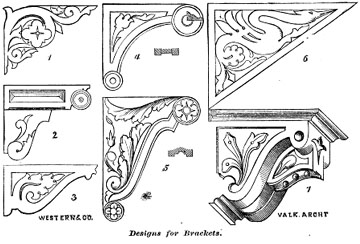
CHASTE yet neat ornaments add much to the appearance of any building, while nakedness on the one hand, and meretricious display on the other are equally displeasing. In very few of the brackets which are seen attached to houses are elegance and simplicity so combined as to produce a pleasing result, and we therefore submit, with great pleasure, the following designs which are from the hand of a well known New York architect. Fig.1. is a scroll piazza bracket, while in Figs. 2, 3, 4, are given designs for cornice brackets of great simplicity and yet remarkable for elegance. Fig.5. shows a cornice bracket of rather more elaborate construction, while in Fig. 7 is seen in perspective a double face bracket, which in its appropriate place would be highly ornamental. Fig. 6 is a triangular scroll bracket. There is no carving on the face of any of these brackets. They can be made as thick as may be required for the style of the building to which they are to be attached, and any carpenter with a little ingenuity and a small amount of practice can lay off and cut out these brackets without assistance.
Disclaimer - All which is found on this website: http://www.victorianpassage.com is meant only for research and/or entertainment purposes. If you use any of the information or try any of the "recipes", or follow any of the antiquated advice on this website, then you do so at your own risk. We shall not be held liable for any damages or anything of the sort that may incur if you use any of the information from this website. Please use caution and safety measures, since our ancestors did not know a lot of the hidden dangers with chemicals and the like. Thank you!
We have scanned in the 1887 Agricultural Almanac so you can download it for free! This e-book contains helpful hints and tips, funny stories, recipes of the time and more. Here are just a few of the titles found Continue reading "Free 1887 Almanac Ebook" »
I couldn't resist publishing the following little "lingo", as it's called, from an 1887 Almanac. Someone long ago devised a special way to find the first day of the month. This dates before 1837 according to the narrative, so it Continue reading "Calendar on Your Fingers" »
Fill in the form below to send us a message. Thanks!