
« The Selection of Wall-Paper. | Main | Old and New Fire Grates. »

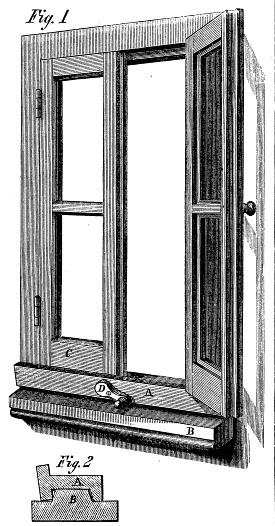
These windows, so very elegant in appearance, and convenient in domestic architecture, have long labored under the disadvantage of not being weather-tight; and, as the same form of window properly prevails in English Gothic and Italian styles, it has been a source of much trouble to builders. The difficulty arising from shrinkage was deemed insurmountable; and architects were forced to insert casings in the walls over their windows, into which the lower sash, being one third longer than the upper one, could slide up, so as to leave an entrance to a balcony or piazza. In this way they had to avoid the use of the casement or French sash. Casements made to slide back into the sides are the exemplification of an old method of avoiding the difficulty. But they have objectionable features also, not the least of which is the expense of casing.. The accompanying illustration represents a simple and most effective device to the end of obtaining a really water-tight window.
As may be plainly seen in the cut A, Fig. 1, represents the slip; B, the window-sill; C, the bottom rail of the window-sash; and D, the button-lift. In Fig. 2, A shows the slip, and B the window-sill.
- Taken from Manufacturer and Builder March 1869
Disclaimer - All which is found on this website: http://www.victorianpassage.com is meant only for research and/or entertainment purposes. If you use any of the information or try any of the "recipes", or follow any of the antiquated advice on this website, then you do so at your own risk. We shall not be held liable for any damages or anything of the sort that may incur if you use any of the information from this website. Please use caution and safety measures, since our ancestors did not know a lot of the hidden dangers with chemicals and the like. Thank you!
We have scanned in the 1887 Agricultural Almanac so you can download it for free! This e-book contains helpful hints and tips, funny stories, recipes of the time and more. Here are just a few of the titles found Continue reading "Free 1887 Almanac Ebook" »
I couldn't resist publishing the following little "lingo", as it's called, from an 1887 Almanac. Someone long ago devised a special way to find the first day of the month. This dates before 1837 according to the narrative, so it Continue reading "Calendar on Your Fingers" »
Fill in the form below to send us a message. Thanks!