<?xml version="1.0" encoding="utf-8"?>
<feed xmlns="http://www.w3.org/2005/Atom">
   <title>A Victorian Passage</title>
   <link rel="alternate" type="text/html" href="http://www.victorianpassage.com/" />
   <link rel="self" type="application/atom+xml" href="http://www.victorianpassage.com/atom.xml" />
   <id>tag:,2010:/2</id>
   <updated>2010-01-18T16:35:08Z</updated>
   <subtitle>A Victorian Passage into time is discovering how the Victorians really lived. From hair decor to antique tools we invite you to see how our ancestors lived!</subtitle>
   <generator uri="http://www.sixapart.com/movabletype/">Movable Type Pro 4.21-en</generator>


<entry>
   <title>Secret Floor Stains</title>
   <link rel="alternate" type="text/html" href="http://www.victorianpassage.com/2010/01/secrets_for_staining_floors.php" />
   <id>tag:www.victorianpassage.com,2010://2.3127</id>
   
   <published>2010-01-18T12:52:49Z</published>
   <updated>2010-01-18T16:35:08Z</updated>
   
   <summary> WITH the spread of Anglo-mania, smooth, bare floors, in early English style, have grown more and more popular, and wealthy men pay more dollars per square foot than I care to specify, for rosewood, mahogany, West India cherry, and...</summary>
   <author>
      <name>Jessica</name>
      <uri>http://ridgetops.victorianpassage.com</uri>
   </author>
   
      <category term="1890" scheme="http://www.sixapart.com/ns/types#category" />
   
      <category term="2" scheme="http://www.sixapart.com/ns/types#category" />
   
      <category term="4" scheme="http://www.sixapart.com/ns/types#category" />
   
      <category term="5" scheme="http://www.sixapart.com/ns/types#category" />
   
      <category term="Interior Design" scheme="http://www.sixapart.com/ns/types#category" />
   
   <category term="376" label="1890" scheme="http://www.sixapart.com/ns/types#tag" />
   <category term="580" label="Floors" scheme="http://www.sixapart.com/ns/types#tag" />
   <category term="578" label="The Home-Maker" scheme="http://www.sixapart.com/ns/types#tag" />
   <category term="249" label="Victorian" scheme="http://www.sixapart.com/ns/types#tag" />
   
   <content type="html" xml:lang="en" xml:base="http://www.victorianpassage.com/">
      <![CDATA[<span class="mt-enclosure mt-enclosure-image" style="display: inline;"><img alt="scrtflrstains.jpg" src="http://www.victorianpassage.com/pics/scrtflrstains.jpg" width="400" height="301" class="mt-image-none" style="" /></span>

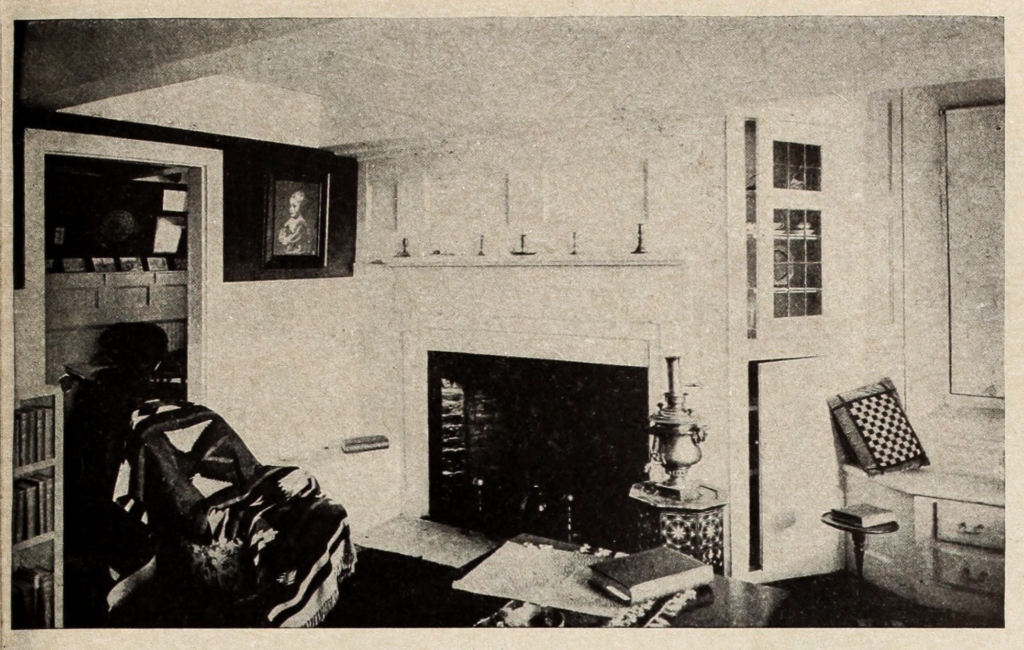
WITH the spread of Anglo-mania, smooth, bare floors, in early English style, have grown more and more popular, and wealthy men pay more dollars per square foot than I care to specify, for rosewood, mahogany, West India cherry, and antique oak floors, solid, not veneered. And yet, with all this lavish expense, there are few of them more beautiful than some which might have been seen in old Virginia houses, floors of native oak or forest pine, conscientiously put together by a country carpenter, and polished, year after year, with the " dry-rubbin'-bresh," well waxed. Many were satisfied with the native beauty of the wood thus polished, but others used stains, and there was much friendly rivalry among neighboring housekeepers, as to the relative merits of their floors. 

At one old homestead, the hall and parlor floors were a dark red color like old mahogany; floors on which the visitor involuntarily hesitated to tread. The secret of their dye was known only to the stately Negro majordomo and his mistress, nor was it until the latter lay on her death-bed that she divulged it. In one corner of the plantation was a peculiar red mud, and this, mixed in hickory lye, was applied to the floors, allowed to dry, then rubbed off and the boards polished. This process repeated again and again, year after year, gave the rare rich hue to the old floors. In another old homestead every floor in summer, except those of the bedrooms, which were covered with matting, was left bare, and even an expert would have been sure they were yellow oak, yet they were only pine. Here the mistress made no secret of her method. Strong lye leached from oak and hickory ashes, applied boiling hot, and followed by wax and rubbing.

I remember one especially beautiful floor which was the fruit of invention stimulated by dire necessity. The family moved during the war into a house, in which the parlor floor had become badly weather-stained.

A parlor carpet in those days was as unattainable as a roc's eggs, so there was naught left but to stain the floor, and the stain to be effective must be dark. A strong decoction of chestnut oak bark was applied three times, boiling hot, plank by plank, each time being well rubbed in and suffered to dry. Finally comes the wax and polishing with the brush, this last repeated three or four times every week. Each summer the bark dye was renewed in one application, and in a few years the floor looked like highly polished black walnut, and passing across it you might plainly see your shadow reflected in the wood.
<em>- The Home-Maker April 1890 </em>]]>
      
   </content>
</entry>

<entry>
   <title>Free Taylor&apos;s Bazaar Trade Card</title>
   <link rel="alternate" type="text/html" href="http://www.victorianpassage.com/2009/12/free_taylors_bazaar_trade_card.php" />
   <id>tag:www.victorianpassage.com,2009://2.3119</id>
   
   <published>2009-12-31T23:54:24Z</published>
   <updated>2010-01-01T00:08:45Z</updated>
   
   <summary> We have for download this Victorian trade card. The card is roughly 3 inches x 5 inches at 600 dpi. Download Taylor&apos;s Bazaar Trade Card HERE Enjoy!...</summary>
   <author>
      <name>Jessica</name>
      <uri>http://ridgetops.victorianpassage.com</uri>
   </author>
   
      <category term="Freebies" scheme="http://www.sixapart.com/ns/types#category" />
   
   <category term="393" label="Freebies" scheme="http://www.sixapart.com/ns/types#tag" />
   <category term="576" label="Trade Card" scheme="http://www.sixapart.com/ns/types#tag" />
   
   <content type="html" xml:lang="en" xml:base="http://www.victorianpassage.com/">
      <![CDATA[<span class="mt-enclosure mt-enclosure-image" style="display: inline;"><img alt="taylors-bazaar-vic-trade-card-sm.jpg" src="http://www.victorianpassage.com/pics/taylors-bazaar-vic-trade-card-sm.jpg" width="400" height="723" class="mt-image-none" style="" /></span>

We have for download this Victorian trade card. The card is roughly 3 inches x 5 inches at 600 dpi. 

<strong>Download Taylor's Bazaar Trade Card<a href="http://www.victorianpassage.com/ccount/click.php?id=4"> HERE</a></strong>

Enjoy!]]>
      
   </content>
</entry>

<entry>
   <title>What Is Bluing?</title>
   <link rel="alternate" type="text/html" href="http://www.victorianpassage.com/2009/11/what_is_bluing.php" />
   <id>tag:www.victorianpassage.com,2009://2.3110</id>
   
   <published>2009-11-16T13:38:33Z</published>
   <updated>2009-12-28T04:41:00Z</updated>
   
   <summary> If you open any cookbook or other domestic book for house keepers you will usually find instructions on how to do laundry. Inevitably you will come upon the rinsing of clothes to be done by putting into bluing. This...</summary>
   <author>
      <name>Jessica</name>
      <uri>http://ridgetops.victorianpassage.com</uri>
   </author>
   
      <category term="1860" scheme="http://www.sixapart.com/ns/types#category" />
   
      <category term="1870" scheme="http://www.sixapart.com/ns/types#category" />
   
      <category term="1880" scheme="http://www.sixapart.com/ns/types#category" />
   
      <category term="1890" scheme="http://www.sixapart.com/ns/types#category" />
   
      <category term="1900" scheme="http://www.sixapart.com/ns/types#category" />
   
      <category term="1910" scheme="http://www.sixapart.com/ns/types#category" />
   
      <category term="2" scheme="http://www.sixapart.com/ns/types#category" />
   
      <category term="3" scheme="http://www.sixapart.com/ns/types#category" />
   
      <category term="4" scheme="http://www.sixapart.com/ns/types#category" />
   
      <category term="5" scheme="http://www.sixapart.com/ns/types#category" />
   
      <category term="Articles" scheme="http://www.sixapart.com/ns/types#category" />
   
      <category term="Domestic Life" scheme="http://www.sixapart.com/ns/types#category" />
   
   <category term="558" label="1866" scheme="http://www.sixapart.com/ns/types#tag" />
   <category term="545" label="1880" scheme="http://www.sixapart.com/ns/types#tag" />
   <category term="568" label="Blue Monday" scheme="http://www.sixapart.com/ns/types#tag" />
   <category term="565" label="bluing" scheme="http://www.sixapart.com/ns/types#tag" />
   <category term="566" label="laundry" scheme="http://www.sixapart.com/ns/types#tag" />
   <category term="560" label="Mrs.Stewart&apos;s" scheme="http://www.sixapart.com/ns/types#tag" />
   <category term="562" label="Pyle&apos;s" scheme="http://www.sixapart.com/ns/types#tag" />
   <category term="564" label="Sawyer&apos;s" scheme="http://www.sixapart.com/ns/types#tag" />
   <category term="249" label="Victorian" scheme="http://www.sixapart.com/ns/types#tag" />
   <category term="570" label="Washing" scheme="http://www.sixapart.com/ns/types#tag" />
   
   <content type="html" xml:lang="en" xml:base="http://www.victorianpassage.com/">
      <![CDATA[<span class="mt-enclosure mt-enclosure-image" style="display: inline;"><img alt="bluine.jpg" src="http://www.victorianpassage.com/pics/bluine.jpg" width="363" height="417" class="mt-image-none" style="" /></span>

If you open any cookbook or other domestic book for house keepers you will usually find instructions on how to do laundry. Inevitably you will come upon the rinsing of clothes to be done by putting into bluing. This is what was commonly used to brighten whites. In it's earliest forms it was used by having indigo tied in a thin muslin bag and shaken in the water until the right shade was produced to brighten whites. But natural indigo was of a darker blue color and dull according to some. In addition it was costly to manufacturer so when other cheaper and brighter blues were made the indigo bluing fell out of general use. 

<span class="mt-enclosure mt-enclosure-image" style="display: inline;"><img alt="sawy-blu.jpg" src="http://www.victorianpassage.com/pics/sawy-blu.jpg" width="269" height="454" class="mt-image-none" style="float:right; padding:5px" /></span>

By the early part of the twentieth century there were many kinds of bluing being used. Besides Indigo, there was ultramarine, Prussian blue, aniline blue, and then Indigo manufactured chemically. Some bluing was sold as liquid form and others were found in solid form. 

Ultramarine blue originally came from the stone lapis lazuli, which was ground fine. Then it was manufactured chemically. It has a bright color and was commonly used in the home by the early 1900's. In the marketplace this form could be found in little balls. 

Prussian blue is from a chemical origin from iron as one of its bases. It is of a bright blue color and sold in liquid form, even found on the market today. One source claims that if the clothes are not thoroughly rinsed or if any of the blue was left in the clothes, the iron in its composition would unite with the alkali of the soap and iron rust spots would appear on the clothes. Many people, however, have had a lot of success with Mrs.Stewart's bluing which is sold in many stores today.

Aniline blue was a strong dye and only a small quantity was required. It was sold in either solid or liquid form. In the early 1900s it was cheaper and more effective and gave a good clear color. It was used more by public laundries than housekeepers in general.

I've also seen Chinese blue mentioned in the making of bluing. Just a few companies that made bluing that I ran across were Pyle's, Bluine, and Sawyer's. Now if you are looking to make your own bluing you can try the following recipe from 1866:

Take best Prussian-blue, pulverized, 1 oz.; Oxalic acid, also pulverized, 1/2 oz.; soft water 1 qt. Mix.  The acid dissolves the blue and holds it evenly in the water, so that specking will never take place. One or two table-spoons of it is sufficient for a tub of water, according to the size of the tub.

<em>And a variant of the above recipe from the 1880s:</em>
One ounce soft Prussian blue, 1/4 ounce Oxalic acid, and 1 gallon soft water. One teaspoon is enough for a large wash.

<a href="http://www.mrsstewart.com/">Mrs. Stewart's</a> have similar ingredients to the above recipe, except that they have added a ph balancer. Their liquid form of bluing is highly concentrated so you only need about 1/4th a teaspoon which is put into a quart of water and stirred before adding to a full size load of wash. You can use their store locater to find where they are sold. I found it in my local Kroger's. 

And although we have <a href="http://www.victorianpassage.com/2008/11/how_blue_monday_was_named.php">Pearline's</a> humorous account for how Monday came to be called Blue Monday the more likely cause is <em>Bluing</em>. ]]>
      
   </content>
</entry>

<entry>
   <title>Unfolding the Mysteries of Sealing Wax and Wafers</title>
   <link rel="alternate" type="text/html" href="http://www.victorianpassage.com/2009/07/unfolding_the_mysteries_of_sea.php" />
   <id>tag:www.victorianpassage.com,2009://2.2972</id>
   
   <published>2009-07-15T19:28:48Z</published>
   <updated>2009-12-16T19:57:53Z</updated>
   
   <summary> Introduction To Sealing Wax and Wafers In the 19th century, sealing wax was a material made by the melting of lac or rosin with turpentine and pigments. In it&apos;s earliest forms it would have been made of beeswax and...</summary>
   <author>
      <name>Jessica</name>
      <uri>http://ridgetops.victorianpassage.com</uri>
   </author>
   
      <category term="1" scheme="http://www.sixapart.com/ns/types#category" />
   
      <category term="1830" scheme="http://www.sixapart.com/ns/types#category" />
   
      <category term="1840" scheme="http://www.sixapart.com/ns/types#category" />
   
      <category term="1850" scheme="http://www.sixapart.com/ns/types#category" />
   
      <category term="1860" scheme="http://www.sixapart.com/ns/types#category" />
   
      <category term="1870" scheme="http://www.sixapart.com/ns/types#category" />
   
      <category term="1880" scheme="http://www.sixapart.com/ns/types#category" />
   
      <category term="1890" scheme="http://www.sixapart.com/ns/types#category" />
   
      <category term="2" scheme="http://www.sixapart.com/ns/types#category" />
   
      <category term="4" scheme="http://www.sixapart.com/ns/types#category" />
   
      <category term="5" scheme="http://www.sixapart.com/ns/types#category" />
   
      <category term="Articles" scheme="http://www.sixapart.com/ns/types#category" />
   
      <category term="Etiquette and Social Life" scheme="http://www.sixapart.com/ns/types#category" />
   
   <category term="142" label="1830" scheme="http://www.sixapart.com/ns/types#tag" />
   <category term="542" label="1840" scheme="http://www.sixapart.com/ns/types#tag" />
   <category term="543" label="1850" scheme="http://www.sixapart.com/ns/types#tag" />
   <category term="544" label="1860" scheme="http://www.sixapart.com/ns/types#tag" />
   <category term="185" label="1870" scheme="http://www.sixapart.com/ns/types#tag" />
   <category term="545" label="1880" scheme="http://www.sixapart.com/ns/types#tag" />
   <category term="376" label="1890" scheme="http://www.sixapart.com/ns/types#tag" />
   <category term="547" label="Envelopes" scheme="http://www.sixapart.com/ns/types#tag" />
   <category term="193" label="Etiquette" scheme="http://www.sixapart.com/ns/types#tag" />
   <category term="549" label="Letters" scheme="http://www.sixapart.com/ns/types#tag" />
   <category term="551" label="Postal" scheme="http://www.sixapart.com/ns/types#tag" />
   <category term="553" label="Recipes" scheme="http://www.sixapart.com/ns/types#tag" />
   <category term="555" label="Sealing Wax" scheme="http://www.sixapart.com/ns/types#tag" />
   <category term="249" label="Victorian" scheme="http://www.sixapart.com/ns/types#tag" />
   <category term="557" label="Wafers" scheme="http://www.sixapart.com/ns/types#tag" />
   
   <content type="html" xml:lang="en" xml:base="http://www.victorianpassage.com/">
      <![CDATA[<span class="mt-enclosure mt-enclosure-image" style="display: inline;"><img alt="sealing-wax-red2b.jpg" src="http://www.victorianpassage.com/pics/sealing-wax-red2b.jpg" width="250" height="230" class="mt-image-left" style="float: left; margin: 0 20px 20px 0;" /></span>

<strong>Introduction To Sealing Wax and Wafers</strong>
In the 19th century, sealing wax was a material made by the melting of lac or rosin with turpentine and pigments. In it's earliest forms it would have been made of beeswax and resin. The sealing wax was used to "seal" the letters or envelopes, with or without a wafer. During the early to mid 19th century the use of the wafer became popular in less formal correspondence. Often times people would imprint their sealing wax with initials, coat of arms, or other insignia as their personal mark on the sealing wax. With the onset of gummed envelopes, however, sealing wax and wafers eventually took a brief repose. By the 1870s few were using sealing wax, wafers and folded letters without envelopes. In the 1880's sealing wax was confined to those courtly correspondences, express parcels containing valuables for security, money parcels sent by express or foreign dispatches. However, you also always had those who of the "old school" still used it in all formal letters and notes. It was seen that sealing wax in the 1880s was more commonly used in Great Britain than in America. But it began to gain acceptance and popularity again, especially in America, in the 1880s and 1890s.

<strong>How Sealing Wax Was Made</strong> 
Some early common kinds of sealing wax were called Indian and Dutch, both being red. Sealing wax was made into many colors. Black sealing wax was made with the common lamp black. The golden sealing wax used powdered yellow mica or cat gold instead of vermilion like the Indian and Dutch used. The shellac and turpentine formed a brownish red transparency which allowed the mica to be seen and formed a sort of aventurine. Sometimes sealing wax was marbled by working the two, three or more colored waxes together when in a semi-fluid state. The French even went so far as to perfume the sealing wax, commonly with musk, or some other perfume. 

Sealing wax came in sticks. In the early part of the 19th century they were made on a marble slab which was fixed in a frame with a chafing dish placed under the slab to keep the marble at the proper temperature. The wax was first rolled upon this warmed slab with the hands until it was reduced to a roll nearly the length of six sticks, and then brought to the exact length by being rolled with a square piece of hard wood with a handle. The sticks were then transferred onto a cold marble slab and rolled with a marble roller until quite cold. To polish the stick it was placed between two charcoal fires which were at a small distance opposite of one another. This was done until the surface was smooth and beginning to melt, constantly turning the stick. As the long sticks grow hard the length of each of the six future small sticks are deeply indented in their proper places. Then they are broken into the smaller sticks and finished them by holding the ends to the flame of a lamp and impressing on one end of the stick the manufacturer's mark. If the sealing wax was oval shaped, channeled or ornamented then it was made by pouring the mix into steel molds.

<strong>How to Apply A Seal and Sealing Wax</strong>
When sealing a letter using sealing wax, a wax taper {I believe these were made from wax and tallow} in a low stand was used. Lamps or candles were avoided since they could begin to smoke and blacken the wax. When you began to melt your wax it was suggested you rest your elbow on the table in order to keep your hand steady. You would have taken the stick of wax between your thumb and finger, held it above the light so that it barely touches the point of the flame. Turn the stick around until softened on all sides. Then you would have inserted a little of the melted wax under the turn-over part of the letter, just where the seal is to come. 

This would give more stability to your seal than if it was entirely depended on the outside seal. Or you could have slipped a small wafer of white or the same color as the wax beneath the turn-over. Then begin at the outer edge of the area where the seal is supposed to go. Move the wax in a circle which must gradually diminish until it terminates at the center. Put the seal exactly to the middle of the soft wax. Press it down hard, but do not move it in a circle, then lift straight up.

<strong>How Wafers Were Made</strong> 
These are sort of like a predecessor to a sticker. Wafers were made from wheat flour which was mixed with water so as to form a thin smooth paste. The paste was then pressed between two thin polished iron plates, so joined as to form, when closed, a pair of "wafer tongs". The plates didn't quite touch each other but are separated by a space as thick as the wafers are required. The iron plates when used are slightly warmed and greased, filled with the paste, closed and held for a few moments over a charcoal fire. The heat sets the paste and on separating the tongs a thin sheet of polished dry brittle wafer will come out. Several of these are stacked and then cut into small circular wafers by means of a punch. If made only with flour then they are white, but they are oftentimes colored by mixing lamp black, gamboge, Indigo, Vermilion, and Red Lead. Transparent wafers were made of fine glue, or isinglass. After the introduction of gumming, some fancy wafers were cut from gilt or silver paper, gummed on the lower surface and usually embossed.

<strong>How to Apply A Wafer</strong>
To use a wafer to fasten papers and letters depends on the wafer becoming soft and adhesive when it is moistened. In this state it is placed between two pieces of paper, and the latter pressed together. The wafer adheres to both pieces of paper and when it dries unites them the same way as glue would.

<span class="mt-enclosure mt-enclosure-image" style="display: inline;"><img alt="gold-sealingwax.jpg" src="http://www.victorianpassage.com/pics/gold-sealingwax.jpg" width="400" height="341" class="mt-image-none" style="" /></span>

<strong>In Etiquette</strong>
Well etiquette, obviously, changes over the years in regards to everything. One year one thing is right to do another year it's not. And so was the case with sealing wax etiquette.  So I will give some basics of etiquette based on the decades I found information for:

<em>1840's </em>
It showed a lack of respect if you used a wafer to seal your envelope. 
Men usually used red. 
Ladies used gilt, rose, and other colors. 
When in mourning you used black seals. 
When writing to someone in mourning you used black edged paper and a black seal. 
Using red sealing wax when writing to someone in mourning was considered rudeness or ignorance. 
Large seals were considered bad taste. 
The smaller and glossier the better. 
A small letter gets one seal, a larger letter two. 
If it contains important paper or documents it should receive three or more, according to the size of envelope. 
If using a person to carry a letter as a favor, it was rude to add more than one seal. 
If your letter was folded in a manner that partly opened it at the end, its contents being able to be read, then it was impolite to put a little wax upon the edges. Only when sent by post or by domestic would this be acceptable. 
When not using an envelope and the third part of the letter is written upon you would have left a small blank space where the seal was to be put so as to not cover over any words of the letter. 
When staying overnight, and so as to not trouble your hostess, always carry a well furnished paper-case, pens, pencil, India-rubber, wafers, sealing-wax, and seals. 

<em>1850s</em>
Do not use motto seals unless writing to a member of your own family, or to an intimate friend. 
For common service, (and particularly for letters of business,) a plain seal, with simply your initials, is best.
For a note always use a very small seal. 

<em>1870s</em>
Sealing wax went out of fashion. {However, it was still being used by some}

<em>1880s</em>
Red wax seals are used in business. 
Black for mourning.
Five tints of blue are made to express all gradations of passion. 
Pink is for congratulations. 
White for weddings and invitations.
Square envelopes are the fashion, esp when sealed with wax.
Either use perfumed wax or perfumed letter, but not both, that would be vulgar.  

<em>1890s</em>
Invitations and their replies should be sealed with wax.
Red and black seals are proper. 
Only neat seals are considered worthy.
Wafers were not to be used. 
Private letters should use dark green or red.
Seal should have your monogram, and if you must your crest, but never your coat of arms. 
Men sealing their letters used seal rings or a little stamp that was obtained by a silversmith. 
In France different colored waxes were used for different occasions: 
- white for communication relating to weddings
- black for obituaries
- violet for sympathy
- chocolate for dinner invitations
- red for business
- ruby for engaged lovers' letters to one another
- green for letters from lovers who live in hopes
- brown for refusals of marriage offers. 
- blue denotes constancy 
- yellow jealously
- pale green reproaches
- pink used by young girls
- grey used between friends

<strong>Tricky Merchants</strong>
Sealing wax made with only rosin or a portion of rosin used in place of shellac was considered an inferior quality. You could tell this by running the wax near a flame and it would run into thin drops. Other substitutes considered to be a lousy candidate was if red lead or bole was used in place of Vermilion and common Turpentine used instead of Venice. A cheap red wax would often times look purplish or brownish after it was melted. Even in the 19th century buyers had to beware, since some manufacturers were making the sticks of sealing wax appear to be of a better quality. They did this by softening the surface of the inferior wax, then rolling it in a box of powdered higher quality sealing wax, then once again softened to melt the false coat and then they gave it the last polish. So it appeared a higher quality, but it was only "skin deep". 

<strong>Economical</strong> 
In the 1830s, a seemingly practical and economical solution was presented to public offices where letters sealed with wax would accumulate in great quantities. Two methods were described, and evidently were being put in practice in France, to remove the wax seals from the paper. The first was to pulverize the whole in an iron mortar, and then separate by use of sieves of the proper degree of coarseness. The second, and I think would be easier method, was to place the "mixture" in a wire basket with open meshes and expose it to steam. The wax then would melt, run through and separate from the paper. Then the wax could be collected and re-melted into sticks of sealing wax to use once again.

<strong>A Few Antiquated Recipes</strong>
<em>Civil War Era Red Sealing Wax </em>
4 lbs shellac
1 1/2 lb Venice Turpentine
3 lbs Cinnabar
4 oz Vermilion

Mix whole together and melt over a very slow fire. Pour it on a thick smooth glass, or any other smooth surface and make it into 3, 6 or 10 cent sticks. To stamp it, it should be re-warmed, which will give it the gloss. 


<em>Civil War Era Black Sealing Wax</em>
3lbs Black Rosin
1/2 lb beeswax
1lb Ivory Black
1/4th lb Venice Turpentine

Melt whole together over a slow fire and pour into sticks as above. 

<strong>Links</strong>
Here are a few links that sell traditional sealing wax for those who might be interested. 

<a href="http://www.nostalgicimpressions.com/Traditional_or_Glue_Gun_Sealing_Waxes_s/1.htm">Nostalgic Impressions</a>

<a href="http://www.letterseals.com/">Letter Seals</a>]]>
      
   </content>
</entry>

<entry>
   <title>The Linen Press</title>
   <link rel="alternate" type="text/html" href="http://www.victorianpassage.com/2009/07/the_linen_press.php" />
   <id>tag:www.victorianpassage.com,2009://2.2971</id>
   
   <published>2009-07-08T14:52:14Z</published>
   <updated>2009-07-08T15:30:10Z</updated>
   
   <summary> To those who love housekeeping or who feel an interest in it for duty&apos;s sake, the charge of linen and the great care it requires is one of equal importance with the store-closet. It is a pity to trust...</summary>
   <author>
      <name>Jessica</name>
      <uri>http://ridgetops.victorianpassage.com</uri>
   </author>
   
      <category term="1880" scheme="http://www.sixapart.com/ns/types#category" />
   
      <category term="2" scheme="http://www.sixapart.com/ns/types#category" />
   
      <category term="4" scheme="http://www.sixapart.com/ns/types#category" />
   
      <category term="5" scheme="http://www.sixapart.com/ns/types#category" />
   
      <category term="Domestic Life" scheme="http://www.sixapart.com/ns/types#category" />
   
   
   <content type="html" xml:lang="en" xml:base="http://www.victorianpassage.com/">
      <![CDATA[<span class="mt-enclosure mt-enclosure-image" style="display: inline;"><img alt="linen-press.jpg" src="http://www.victorianpassage.com/pics/linen-press.jpg" width="298" height="403" class="mt-image-none" style="" /></span>

To those who love housekeeping or who feel an interest in it for duty's sake, the charge of linen and the great care it requires is one of equal importance with the store-closet. It is a pity to trust to finding a linen-closet in any house. If you do find one in a house that has been occupied it forms part of that delightful category of articles and fixtures which demand a premium. Therefore we should advise people when they furnish to have a really good linen-closet made of cedar wood or polished pine just as you would require a sideboard or a book-case. Do not have more than five shelves It is a great mistake to have too high a linen-press; the upper shelves only get covered with dust. A portable linen-press and a portable store-closet are two very necessary comforts in a house for they can be put into the regulation "smoking room" and are much more convenient to the mistress of a house when placed there than in the basement and it also saves a great deal of labor to servants. We always feel that it is more comfortable to have linen stores and extra glass and china on the dining-room floor, if we can possibly manage it. 


Nothing does a lady more credit in housekeeping than her linen-press and how any woman who has not a housekeeper can engage the present ordinary style of housemaid to take charge of the linen we cannot imagine, that is, if she has any pride in her house and table linen. There is a good deal of mind and refinement needed in the care and arrangement of a linen-press.


Young and inexperienced housekeepers must remember that no good housekeeping can be done without taking pains and trouble nor without great industry. As to the first purchasing of house and table linen it is not a difficult thing to advise others about. It is so different from quantities of bread meat and groceries which of course vary in every house but with the exception of a larger or smaller number of beds the same arrangement of linen is required in every gentleman's house. 


To begin with old linen:  for years we have adopted plan of giving the members of the family their own and distinct set of sheets, bolster-cases and pillow-cases also bedroom-towels and in addition to the name of the master of the house, we put the name of the individual whose bed and room it is for. Of course in the case of the servants things, we put their particular calling as a mark and not their personal names, as they are like Easter movable feasts. For every member of the family have three pairs of sheets for every servant have two pairs and for wear, color and comfort have linen. Cotton sheets never look well and like cretonne they pick up every particle of dust and as to their being better for health we think as long as we wear long cloth night dresses we are sufficiently protected in the matter of health. No linen is so pretty as the Irish but for long wear and for improving in washing none can excel the Yorkshire. For each member of the family we would therefore recommend Barnsley linen sheeting, sufficient for three pairs for each bed. 


For each person have two bolster-cases and six pillow-cases, these eight articles to be made for beauty's sake of Irish linen. For each member of the family have twelve towels. Let four be Turkish or bath towels of linen, four of strong huckaback and four embossed. In buying toweling by the yard, allow thirteen yards to a dozen towels as the hems reduce a yard too much. For each visitor's room we consider two pairs of sheets sufficient and let them be of Irish linen. Visitors must have clean sheets each week but a fortnight is a reasonable time for all the others. For each servant have two pairs of sheets of strong Barnsley linen. If you prefer cotton, do not get that make that used to be called Bolton sheeting, for one way of the threads is so much stronger than the other that it wears badly. For cotton sheeting nothing wears so well as twilled cotton. 


Give each servant three pillow-cases of strong linen. Never have strings to your pillow cases always buttons and button holes very close together. For each servant have four huckaback towels. Cover all pillows and bolsters with long cloth or linen sewed on and once a year have it picked off and washed. Cover palliasses, mattresses and feather beds with glazed brown Holland {an unbleached linen} made to fit and button and once a year have them cleaned and re-calendered. 


<em>Potter's American Monthly 1881</em>]]>
      
   </content>
</entry>

<entry>
   <title>The Strawberry</title>
   <link rel="alternate" type="text/html" href="http://www.victorianpassage.com/2009/06/the_strawberry.php" />
   <id>tag:www.victorianpassage.com,2009://2.2652</id>
   
   <published>2009-06-01T04:00:00Z</published>
   <updated>2009-12-28T04:41:54Z</updated>
   
   <summary> June and Strawberries Half a dozen people, more or less, have been credited with the saying, &quot;Doubtless, God could have made a better berry, but doubtless God never did;&quot; and the declaration regarding this most delicious and wholesome of...</summary>
   <author>
      <name>Jessica</name>
      <uri>http://ridgetops.victorianpassage.com</uri>
   </author>
   
      <category term="1890" scheme="http://www.sixapart.com/ns/types#category" />
   
      <category term="2" scheme="http://www.sixapart.com/ns/types#category" />
   
      <category term="4" scheme="http://www.sixapart.com/ns/types#category" />
   
      <category term="5" scheme="http://www.sixapart.com/ns/types#category" />
   
      <category term="Cooking and Recipes" scheme="http://www.sixapart.com/ns/types#category" />
   
   <category term="405" label="1890&apos;s" scheme="http://www.sixapart.com/ns/types#tag" />
   <category term="224" label="1894" scheme="http://www.sixapart.com/ns/types#tag" />
   <category term="2" label="cooking" scheme="http://www.sixapart.com/ns/types#tag" />
   <category term="16" label="Good Housekeeping" scheme="http://www.sixapart.com/ns/types#tag" />
   <category term="138" label="recipe" scheme="http://www.sixapart.com/ns/types#tag" />
   <category term="406" label="strawberry" scheme="http://www.sixapart.com/ns/types#tag" />
   
   <content type="html" xml:lang="en" xml:base="http://www.victorianpassage.com/">
      <![CDATA[<span class="mt-enclosure mt-enclosure-image" style="display: inline;"><img alt="strawberry.jpg" src="http://www.victorianpassage.com/pics/strawberry.jpg" width="400" height="566" class="mt-image-none" style="" /></span>

<em><strong>June and Strawberries</strong></em>

Half a dozen people, more or less, have been credited with the saying, "Doubtless, God could have made a better berry, but doubtless God never did;" and the declaration regarding this most delicious and wholesome of all berries, goes without questioning, no matter by whom it was first uttered. The strawberry, whose name is probably derived from the common and ancient practice of laying straw between the plants to keep the berries clean, is a native of the temperate latitudes of both hemispheres--Europe, Asia, North and South America--and though well known is of but comparatively little value in Southern Europe. This is the reason, doubtless, that the old Greek and Roman poets have omitted to sing its praises. 

In olden times the variety of strawberries was very limited, and the garden was chiefly supplied by transplanting from the wood. This was the earliest species cultivated, and is mentioned in the street cries of London of over 400 years ago. 

The garden of the Bishop of Ely at Holborn was celebrated in 1483 for its strawberries, a fact alluded to by Shakespeare in Richard III, when Gloucester says:-- 

"My Lord of Ely, when I was last in Holborn, 
I saw good strawberries in your garden there; 
I do beseech you send for some of them." 

Old Tusser, in his "Five Hundred Points of Good Husbandry," points out where the best plants of his time were to be procured, and turns them over, with an authoritative air and farmer-like contempt for small things, into feminine hands :-- 

"Wife, into the garden, and set me a plot 
With strawberry roots, the best to be got; 
Such growing abroad, among thorns in the wood, 
Well chosen and picked, prove excellent food." 

The strawberry, aside from its delicious flavor, possesses still other claims to popular favor. It is very easy of digestion, never growing acid by fermentation, as most fruits do, and it is also of medicinal value. The great Linnaeus is reported to have cured himself of the gout by partaking freely of strawberries--a delightfully aesthetic cure, and a most flattering testimonial to the efficacy of the dainty scarlet fruit. 

So easily grown are these luscious berries that the poorest owner of a few feet of ground may revel in an abundance of "Strawberries upturning soft cheeks to the sun." Rosy, blushing berries, eaten from the plant, or as a luxurious concomitant to a perfect breakfast on one of Lowell's "perfect" June days, are certainly to be regarded as Arcadian dainties with a suggestion of Paradise. 

The following tested and sure recipes for making use of the berries, I would fain share with a public that will be appreciative after using. First on the list, then, comes the time-honored and delicious Strawberry Shortcake. 

<em>Strawberry Shortcake</em>
With one quart of flour, mix thoroughly, by sifting, two heaping teaspoonfuls of baking powder and a teaspoonful of salt. Rub in one-quarter of a pound of butter until very smooth, then add two eggs beaten to a froth with one- quarter of a pound of sugar. Add milk or water to make a soft dough, and bake in a very quick oven. Cut open while hot with a knife that has been heated, butter, and spread between the layers the berries which have been sweetened to taste. Sprinkle pulverized sugar over the top, or cover with a meringue made with the white of an egg and a tablespoonful of sugar. 

<em>Strawberry Sauce for Puddings</em>
Beat one large tablespoonful of butter to a cream. Add one and one-half cupfuls of powdered sugar and the beaten white of an egg. Beat all together until very light, and just before serving add one pint of mashed berries. 

<em>Strawberries and Whipped Cream</em>
Place a layer of strawberries in a deep glass dish and sprinkle with sugar. Add another layer of berries and sugar until all are used. Whip together one pint of cream, the whites of three eggs and one cupful of pulverized sugar flavored with strawberry juice, and pour over the berries. 

<em>Iced Strawberries</em>
Select large, fine berries, leaving the stems on. Dip in beaten white of egg, then in fine sugar. Dry them; dip again, first in egg, then in sugar, until the icing is of the required thickness. 

<em>Strawberry Ice</em> 
Soak one tablespoonful of gelatine in two tablespoon-fuls of cold water about an hour, then add the same amount of boiling water, and stir until dissolved. Strain and add a pint of strawberry juice, a pint of sugar and one and one-half pints of cold water. Freeze. 

<em>Oranged Strawberries</em>
Place a layer of strawberries in a deep glass dish, and over them sprinkle a layer of pulverized sugar. Add more berries and sugar until all are used. Over all pour orange juice in the proportion of three oranges to one quart of berries. Let it stand for an hour. Sprinkle with pounded ice, and serve. 

<em>Strawberry Cream</em> 
Thoroughly beat the yolks of three eggs with one heaping cupful of granulated sugar. Add one cupful of boiling milk and stir the mixture in a double boiler for four or five minutes. Then add to the hot mixture one pint of very rich cream and the juice of a quart of thoroughly ripe berries. Remove from the fire and cool, then freeze carefully, and serve with dainty white cakes flavored with bitter almond. 

<em>Canned Strawberries (Wiesbaden Method)</em>
Select two lots of berries; large, perfect ones for canning, and inferior ones from which to make the sirup. Put the latter in a colander and pour a very little cold water over them, then to these berries add one-half pound of sugar to each pound of berries, and allow them to stand in a covered earthen jar over night. The next morning drain off most of the juice from the berries and add to the juice one-quarter of a pound of strained honey. Boil this sirup until reduced to one-third the original quantity. While this sirup is boiling, rinse cans, inside and out, with hot water and till with the large whole berries. Fasten the lids on part way, and set in dripping pan on wet towels on the back of the range to keep warm. When the sirup is boiled down one-third, pour quickly over fruit and seal air-tight If you do not care to use the honey according to the Wiesbaden method, use about one-half pound of sugar in its place. It usually takes about three and three- quarter pounds of the large berries to five pounds of the berries to be used for the juice only. 


******

Light and cool desserts are much more acceptable in warm summer days in many ways. The house-keeper is better pleased if she can arrange for dinner in the cool of the morning, and summer fruits are always attractive in any way they may be served. I will venture to give a few recipes that are often used in my own house, hoping they may be of use to others. They may all be used as given, or raspberries may be substituted in place of strawberries.

<em>Jellied Strawberries</em>
One quart of strawberries, carefully freed from sand, should be placed in a quart mold. Soak one-fourth of a box of gelatine in one-half cupful of cold water for two hours; then add to it one and one-fourth cupfuls of boiling water and stir it well until the gelatine is entirely dissolved. Add one cupful of sugar, the juice of one lemon, and one-fourth of a cupful of light wine. Strain this and pour it over the berries. Place the mold in the ice to harden. When ready to serve, dip the mold into warm water, turn the jelly on a dish, and heap whipped cream about it. If one objects to wine, the juice of another lemon, or of an orange, may be used in the place of it. It is better to prepare this dish the day before it is wanted, as jelly requires several hours to become hard in warm weather. Soft custard may be used in place of the whipped cream if preferred. 

<em>Strawberry Whips</em>
For these we require one quart of strawberries, one quart of milk, six eggs, one-half cupful of sugar, one tea-spoonful of vanilla or lemon extract, and one teaspoonful of salt. Put the quart of milk in the double boiler to heat, reserving one-half cupful. Beat four whole eggs and the yolks of two with one-half cupful of sugar, and add the half-cupful of cold milk. Pour this mixture into the boiling milk, stirring the milk constantly while pouring, and until it begins to thicken, when it should be at once removed from the fire and poured immediately into a cold pitcher. Add the salt, and when cold add the flavoring. Some glass custard cups or small tumblers should be partly filled with strawberries. When ready to serve, fill up the glasses with the cold custard. Beat the whites of the two eggs that were reserved from the custard to a stiff froth, add two tablespoonfuls of sugar, then pile it on each glass, and a large strawberry on the top. Or it can be served in one large glass dish, if preferred. 

<em>Strawberry Pudding</em> 
Place one quart of strawberries in a glass dish, and sprinkle over them one-half cupful of sugar. Put one pint of milk in a double boiler; while this heats, beat well together the yolks of three eggs, one-half cupful of sugar, and one-fourth cupful of flour. Stir this into the boiling milk and cook it twenty minutes, stirring often. Remove from the fire and add one-fourth of a teaspoonful of salt. When cold, pour this over the strawberries. Beat the whites of the three eggs to a stiff froth, add three table- spoonfuls of sugar, and heap it on the top of the pudding. Decorate with large strawberries, and the result will be a very delicious, handsome pudding. It may be flavored with vanilla or lemon, if desired. 

<em>Frozen Strawberries</em>
Slightly crush two quarts of strawberries, and add two cupfuls of sugar. This should stand for two hours. Then add one pint of cold water and the juice of one lemon; mix it well, and freeze as you would ice cream. 

<em>Strawberry Foam</em>
Crush one quart of strawberries and sprinkle over them one-half cupful of sugar. Let this stand in a cold place until time to serve. Beat the whites of two eggs to a stiff dry froth, add two tablespoonfuls of sugar, and stir this into the crushed strawberries. Pour it into a glass dish, and decorate with fine whole berries. 

<em>Strawberry Shortcake</em> 
For this dish, the crown of all. I use one and one-half quarts of strawberries, one cupful of sugar, one pint of flour, one and one-half teaspoonfuls of baking powder, one- half teaspoonful of salt, two tablespoonfuls of sugar, one-fourth of a cupful of butter, and a scant half-cupful of milk. Slightly mash the berries and sprinkle over them one cupful of sugar. Measure one pint of flour after it is sifted. Add to it one and one-half teaspoonfuls of baking powder, two tablespoonfuls of sugar, and one-half teaspoonful of salt, then sift again. Rub into the flour one-fourth of a cupful of butter. Mix it with a scant half-cupful of milk. Butter well a Washington pie plate, place the dough upon it, smooth, and press it evenly into the plate with a spoon. Should the dough stick to the spoon, dip a clean spoon in flour and smooth with it. Bake in a quick oven until done--about twelve or fifteen minutes. Remove it to a china plate. Split the cake carefully with a sharp knife. Butler the lower half well and cover with a part of the mashed berries. Place the upper half of the cake on this, the crust side on the berries. Butter this and cover it with the remainder of the fruit. Before serving, heap whipped cream over it, and you have a dish fit for a king. The cake is not to be despised if it be served without whipped cream. 

<em>Good Housekeeping 1894</em>]]>
      
   </content>
</entry>

<entry>
   <title>Cleaning Bottles </title>
   <link rel="alternate" type="text/html" href="http://www.victorianpassage.com/2009/04/cleaning_bottles.php" />
   <id>tag:www.victorianpassage.com,2009://2.1919</id>
   
   <published>2009-04-26T21:42:57Z</published>
   <updated>2009-04-26T21:43:33Z</updated>
   
   <summary> Many persons clean bottles by putting in some small shot and shaking them around. Water dissolves lead to a certain extent, and a film of this lead attaches itself to the sides of the bottle so closely that the...</summary>
   <author>
      <name>Jessica</name>
      <uri>http://ridgetops.victorianpassage.com</uri>
   </author>
   
      <category term="1870" scheme="http://www.sixapart.com/ns/types#category" />
   
      <category term="2" scheme="http://www.sixapart.com/ns/types#category" />
   
      <category term="4" scheme="http://www.sixapart.com/ns/types#category" />
   
      <category term="Domestic Life" scheme="http://www.sixapart.com/ns/types#category" />
   
   
   <content type="html" xml:lang="en" xml:base="http://www.victorianpassage.com/">
      <![CDATA[<span class="mt-enclosure mt-enclosure-image" style="display: inline;"><img alt="glass-bottles.jpg" src="http://www.victorianpassage.com/pics/glass-bottles.jpg" width="386" height="533" class="mt-image-none" style="" /></span>

Many persons clean bottles by putting in some small shot and shaking them around.
Water dissolves lead to a certain extent, and a film of this lead attaches itself to the sides of the bottle so closely that the shaking or rinsing with water does not detach it, and it remains to be dissolved by any liquid which has the least sourness in it, and if drank, lead poison may be the result; sometimes a shot becomes wedged in at the bottom of a bottle, to be dissolved by wine or cider. Therefore it is better to wash every bottle, as soon as emptied, with warm water and wood ashes, or salaratus, and put the bottles away, mouth open and downward; but be careful to wash again when used, as flies and other insects frequently get into open bottles. 

<em>- Manufacturer and Builder 1874</em>]]>
      
   </content>
</entry>

<entry>
   <title>What Becomes of Old Shoes.</title>
   <link rel="alternate" type="text/html" href="http://www.victorianpassage.com/2009/04/what_becomes_of_old_shoes.php" />
   <id>tag:www.victorianpassage.com,2009://2.1918</id>
   
   <published>2009-04-22T04:00:00Z</published>
   <updated>2009-04-21T21:35:36Z</updated>
   
   <summary> A contemporary answers this question by stating that they are cut up in small pieces, and these are put for a couple of days in chloride of sulphur, which makes the leather very hard and brittle. After this is...</summary>
   <author>
      <name>Jessica</name>
      <uri>http://ridgetops.victorianpassage.com</uri>
   </author>
   
      <category term="1870" scheme="http://www.sixapart.com/ns/types#category" />
   
      <category term="2" scheme="http://www.sixapart.com/ns/types#category" />
   
      <category term="4" scheme="http://www.sixapart.com/ns/types#category" />
   
   
   <content type="html" xml:lang="en" xml:base="http://www.victorianpassage.com/">
      <![CDATA[<span class="mt-enclosure mt-enclosure-image" style="display: inline;"><img alt="worn-shoes.jpg" src="http://www.victorianpassage.com/pics/worn-shoes.jpg" width="362" height="282" class="mt-image-none" style="" /></span>

A contemporary answers this question by stating that they are cut up in small pieces, and these are put for a couple of days in chloride of sulphur, which makes the leather very hard and brittle. After this is effected, the material is washed with water, dried, ground to powder, and mixed with some substance which makes time particles adhere together, as shellac, good glue, or thick solution of gumn. It is then pressed into moulds and shaped into combs, buttons, knife-handles, and many other articles.

<em>- Manufacturer and Builder Feb 1870</em>]]>
      
   </content>
</entry>

<entry>
   <title>Wooden Toothpicks.</title>
   <link rel="alternate" type="text/html" href="http://www.victorianpassage.com/2009/04/wooden_toothpicks.php" />
   <id>tag:www.victorianpassage.com,2009://2.2650</id>
   
   <published>2009-04-20T20:35:48Z</published>
   <updated>2009-04-20T21:09:25Z</updated>
   
   <summary> Every eating-house visitor of this city and other leading cities of the Union has doubtless noticed a small tumbler of wooden toothpicks upon the counter of the cashier, for the use of customers. These toothpicks are a good feature...</summary>
   <author>
      <name>Jessica</name>
      <uri>http://ridgetops.victorianpassage.com</uri>
   </author>
   
      <category term="1870" scheme="http://www.sixapart.com/ns/types#category" />
   
      <category term="2" scheme="http://www.sixapart.com/ns/types#category" />
   
      <category term="4" scheme="http://www.sixapart.com/ns/types#category" />
   
      <category term="5" scheme="http://www.sixapart.com/ns/types#category" />
   
      <category term="Cooking and Recipes" scheme="http://www.sixapart.com/ns/types#category" />
   
   <category term="185" label="1870" scheme="http://www.sixapart.com/ns/types#tag" />
   <category term="96" label="Manufacturer and Builder" scheme="http://www.sixapart.com/ns/types#tag" />
   <category term="397" label="Toothpicks" scheme="http://www.sixapart.com/ns/types#tag" />
   <category term="249" label="Victorian" scheme="http://www.sixapart.com/ns/types#tag" />
   
   <content type="html" xml:lang="en" xml:base="http://www.victorianpassage.com/">
      <![CDATA[<span class="mt-enclosure mt-enclosure-image" style="display: inline;"><img alt="toothpicks.jpg" src="http://www.victorianpassage.com/pics/toothpicks.jpg" width="400" height="566" class="mt-image-none" style="" /></span>

Every eating-house visitor of this city and other leading cities of the Union has doubtless noticed a small tumbler of wooden toothpicks upon the counter of the cashier, for the use of customers. These toothpicks are a good feature of the present day. The wooden toothpicks have to a considerable extent superseded the gold, horn, ivory, and other articles of the kind formerly in use. Their manufacture is carried on by but one establishment, which has been in operation four years. It is near Boston, and employs thirty hands of both sexes. The machinery has been patented, and is propelled by water-power. The woods used are maple and willow. The agency is solely in this city, and all purchases for use elsewhere must be made here. The toothpicks are packed in pasteboard boxes of two sizes. One box is three inches long, by two wide and one deep. It contains three hundred, and sells for six cents. The other incloses twenty-five hundred, and is five inches long, three wide and three deep. The boxes are packed in wooden cases for shipment, or retailed in the city singly by the carriers. The sales are quite large, and amount at times to forty or fifty cases a day, each containing one hundred thousand toothpicks. The aggregate number sold, therefore, amounts in that period to four or five millions.

The Manufacturer and Builder 1870

]]>
      
   </content>
</entry>

<entry>
   <title>Free Victorian Playtime E-Papers</title>
   <link rel="alternate" type="text/html" href="http://www.victorianpassage.com/2009/04/free_victorian_playtime_e-pape.php" />
   <id>tag:www.victorianpassage.com,2009://2.2548</id>
   
   <published>2009-04-07T19:06:36Z</published>
   <updated>2009-04-07T21:33:40Z</updated>
   
   <summary> The designer at Edenshale Cottage has created eight Victorian based digital papers that she&apos;s willing to share with our readers here. They are for your personal use in scrapbook and art projects. Some of the papers were designed using...</summary>
   <author>
      <name>Jessica</name>
      <uri>http://ridgetops.victorianpassage.com</uri>
   </author>
   
      <category term="Freebies" scheme="http://www.sixapart.com/ns/types#category" />
   
   <category term="393" label="Freebies" scheme="http://www.sixapart.com/ns/types#tag" />
   <category term="395" label="Papers" scheme="http://www.sixapart.com/ns/types#tag" />
   <category term="105" label="Scrapbook" scheme="http://www.sixapart.com/ns/types#tag" />
   
   <content type="html" xml:lang="en" xml:base="http://www.victorianpassage.com/">
      <![CDATA[<span class="mt-enclosure mt-enclosure-image" style="display: inline;"><img alt="folder-sm.jpg" src="http://www.victorianpassage.com/zips/folder-sm.jpg" width="400" height="533" class="mt-image-none" style="" /></span>

The designer at Edenshale Cottage has created eight Victorian based digital papers that she's willing to share with our readers here. They are for your personal use in scrapbook and art projects. Some of the papers were designed using an old german book of games for children dating about 1888. They were created at 300dpi and are sized 12 inches x 12 inches -  perfect for printing out for your scrapbooking projects.  


<strong>Download Victorian Playtime Paper Pack<a href="http://www.victorianpassage.com/ccount/click.php?id=3"> HERE</a> [Size 37MB]</strong>


<em>You will need to read the edenshale-cottage-TOU.txt file for further information on how you can use the contents within the zip file.If you have any problems downloading and/or viewing the zip file please contact us guide [at] victorianpassage.com Enjoy and Thanks!</em>]]>
      
   </content>
</entry>

<entry>
   <title>Baby&apos;s Announcement Cards.</title>
   <link rel="alternate" type="text/html" href="http://www.victorianpassage.com/2009/03/babys_announcement_cards.php" />
   <id>tag:www.victorianpassage.com,2009://2.2542</id>
   
   <published>2009-03-31T01:03:13Z</published>
   <updated>2009-12-28T04:44:45Z</updated>
   
   <summary>It is quite common now to have cards printed in tiny form, announcing the birth of infants, and giving thereon the name of the new arrival, and weight and day of birth. We have recently received cards from a mother...</summary>
   <author>
      <name>Jessica</name>
      <uri>http://ridgetops.victorianpassage.com</uri>
   </author>
   
      <category term="1890" scheme="http://www.sixapart.com/ns/types#category" />
   
      <category term="2" scheme="http://www.sixapart.com/ns/types#category" />
   
      <category term="4" scheme="http://www.sixapart.com/ns/types#category" />
   
      <category term="5" scheme="http://www.sixapart.com/ns/types#category" />
   
      <category term="Etiquette and Social Life" scheme="http://www.sixapart.com/ns/types#category" />
   
   
   <content type="html" xml:lang="en" xml:base="http://www.victorianpassage.com/">
      <![CDATA[It is quite common now to have cards printed in tiny form, announcing the birth of infants, and giving thereon the name of the new arrival, and weight and day of birth. We have recently received cards from a mother having "two of 'em," and the cards of each are so neat and unique, that we are led to reproduce them here for the suggestions they may convey to other mothers who are anxious to send out something different from the commonplace. 

<span class="mt-enclosure mt-enclosure-image" style="display: inline;"><img alt="bby-cards.jpg" src="http://www.victorianpassage.com/pics/bby-cards.jpg" width="380" height="396" class="mt-image-none" style="" /></span>

No. 1 is that of a boy baby, and is printed in gold on a light blue paper. 

No. 2 is the card of a girl, and is on white board.  

<em>- Babyhood Magazine 1891</em>

<em>Note: Seems like baby announcement cards started becoming popular sometime in the 1870's. According to one advertisement from L. Prang and Company's which said, "Just Out, Something Entirely New!..Birth Announcement Cards, to be used by parents to announce the birth of a child to their friends." This was in 1879. </em>]]>
      
   </content>
</entry>

<entry>
   <title>Old Soap Recipes</title>
   <link rel="alternate" type="text/html" href="http://www.victorianpassage.com/2009/02/old_soap_recipes.php" />
   <id>tag:www.victorianpassage.com,2009://2.1925</id>
   
   <published>2009-02-13T22:07:39Z</published>
   <updated>2009-12-28T04:45:51Z</updated>
   
   <summary> ROSIN Soap {yellow soap}.--Fifteen per cent, of rosin can be saponified with potash or soda lye, and mixed with clear, warm tallow soap to a good purpose; more would deteriorate it, although for the cheapest grade of soaps, thirty-three...</summary>
   <author>
      <name>Jessica</name>
      <uri>http://ridgetops.victorianpassage.com</uri>
   </author>
   
      <category term="1870" scheme="http://www.sixapart.com/ns/types#category" />
   
      <category term="2" scheme="http://www.sixapart.com/ns/types#category" />
   
      <category term="4" scheme="http://www.sixapart.com/ns/types#category" />
   
      <category term="5" scheme="http://www.sixapart.com/ns/types#category" />
   
      <category term="Beauty and Hygiene" scheme="http://www.sixapart.com/ns/types#category" />
   
      <category term="Crafts" scheme="http://www.sixapart.com/ns/types#category" />
   
   
   <content type="html" xml:lang="en" xml:base="http://www.victorianpassage.com/">
      <![CDATA[<span class="mt-enclosure mt-enclosure-image" style="display: inline;"><img alt="soaps.jpg" src="http://www.victorianpassage.com/pics/soaps.jpg" width="284" height="423" class="mt-image-none" style="" /></span>

<strong>ROSIN Soap {yellow soap}</strong>.--Fifteen per cent, of rosin can be saponified with potash or soda lye, and mixed with clear, warm tallow soap to a good purpose; more would deteriorate it, although for the cheapest grade of soaps, thirty-three per cent is often added; but such soaps remain soft and clammy, and are unsatisfactory to the consumer. Twelve gallons of strong lye (30° to 36° Beaume) are needed for l00 lbs. of rosin. Some soap-makers melt it with the fat in the commencement of the boiling of the soap, but experience has shown that it is best to prepare a pure tallow soap first, and afterward mix with it the rosin soap, made in a separate kettle. Both soaps in the hot state are to be thoroughly incorporated, by stirring and beating intimately for half an hour, and the whole passed through a wire sieve before transferring to the frames, and therein also well stirred with the crutch. Some palm oil, when saponified along with the tallow, will much improve the appearance of such a soap. 

The rosin, previous to its being put in contact with the lye, should be ground fine, and while one workman is occupied in throwing it into the boiler containing the hot lye, another should be constantly occupied in stirring it in, as the mixture easily rises. The heat must not be too rapidly increased, nor is it necessary that it should boil all the time, but merely kept near the boiling point, but it is indispensable to keep stirring the mixture all the time, otherwise caking of the rosin will interfere with the progress of the operation. Saponification will lie completed in about two hours, and then it may be added to die fat about being converted into soap, as above described.

<strong>PALM Soap (superior).</strong>--Cut thin two pounds of yellow soap into a double saucepan, occasionally stirring it till it is melted, which will be in a few minutes, if the water is kept boiling around it; then add quarter of a pound of palm oil, quarter of a pound of honey, and six cents worth of true oil of cinnamon; let all boil together another six or eight minutes; pour out, and stand it by till next day. It is then fit for immediate use.

<strong>CINNAMON Soap.</strong>--Palm oil soap, 2 parts; good tallow soap, 3 parts. Reduce to shavings, then liquefy by adding a little water, and placing the mixture in a water bath until perfectly united; next cool to about 135° Fahr., and add finely powdered yellow ochre to color, and a sufficiency of the following perfume : Essence of cinnamon, 7 parts ; essence of bergamot, 2 parts; essence of sassafras, I part. Well mix the whole together and mould.

<strong>ORANGE FLOWER Soap.</strong>--Palm soap, 2 parts; tallow soap, 3 parts. Mix, as for cinnamon soap, and perfume with the following essences : Essence of Portugal, 8 parts; essence of amber, 7 parts. Mix. Color with the following, as required: Red Lead {Note: use a substitute for this color since this is toxic}, 5 parts; yellow green, 33 parts. Mix.

<strong>HONEY Soap.</strong> -- Cut thin two pounds of yellow soap into a double saucepan, occasionally stirring it till it is melted, which will be in a few minutes if the water is kept boiling around it, then add a quarter of a pound of palm oil, quarter of a pound of honey, three pennyworth of true oil of cinnamon; let all boil together another six or eight minutes; pour out and stand it by till next day; it is then fit for immediate use. If made as these directions it will be found to be a very superior soap.

<em>- A Dictionary of Every-day Wants 1872</em>]]>
      
   </content>
</entry>

<entry>
   <title>Advertising and Wrapping Paper</title>
   <link rel="alternate" type="text/html" href="http://www.victorianpassage.com/2009/01/advertising_and_wrapping_paper.php" />
   <id>tag:www.victorianpassage.com,2009://2.1901</id>
   
   <published>2009-01-03T05:00:00Z</published>
   <updated>2009-12-28T04:51:44Z</updated>
   
   <summary> WRAPPING PAPER. The use of wrapping paper as store advertising is a practice that is very generally followed, though not as much since the advent of the roll wrapping paper, which, by the way, can be had printed just...</summary>
   <author>
      <name>Jessica</name>
      <uri>http://ridgetops.victorianpassage.com</uri>
   </author>
   
      <category term="1910" scheme="http://www.sixapart.com/ns/types#category" />
   
      <category term="3" scheme="http://www.sixapart.com/ns/types#category" />
   
      <category term="4" scheme="http://www.sixapart.com/ns/types#category" />
   
      <category term="5" scheme="http://www.sixapart.com/ns/types#category" />
   
   <category term="383" label="1911" scheme="http://www.sixapart.com/ns/types#tag" />
   <category term="237" label="Edwardian" scheme="http://www.sixapart.com/ns/types#tag" />
   <category term="572" label="Hardware Dealers&apos; Magazine" scheme="http://www.sixapart.com/ns/types#tag" />
   <category term="241" label="Packages" scheme="http://www.sixapart.com/ns/types#tag" />
   <category term="387" label="Paper" scheme="http://www.sixapart.com/ns/types#tag" />
   <category term="389" label="Parcel" scheme="http://www.sixapart.com/ns/types#tag" />
   <category term="391" label="Store" scheme="http://www.sixapart.com/ns/types#tag" />
   <category term="243" label="Wrapping" scheme="http://www.sixapart.com/ns/types#tag" />
   
   <content type="html" xml:lang="en" xml:base="http://www.victorianpassage.com/">
      <![CDATA[<span class="mt-enclosure mt-enclosure-image" style="display: inline;"><a href="http://www.victorianpassage.com/pics/store-wrap2.jpg"><img alt="store-wrap2.jpg" src="http://www.victorianpassage.com/assets_c/2009/01/store-wrap2-thumb-400x321.jpg" width="400" height="321" class="mt-image-none" style="" /></a></span>

WRAPPING PAPER. The use of wrapping paper as store advertising is a practice that is very generally followed, though not as much since the advent of the roll wrapping paper, which, by the way, can be had printed just as well as the sheet paper can. Some stores make it a point to use in all instances a wrapping paper of a uniform color and that color a very strong, prominent one. There is no doubt but that a distinctive color can be made, especially in a small place, representative of a certain store. This, however, is not a sufficient excuse for loading up your customers with bizarre looking parcels which will make them look like walking posters. A man may not always be particular about the kind of parcels he carries, but a woman always is -- and then I can understand that a man who himself has for good customers several merchants in the same line of goods may not want to advertise to all the rest the fact that he has just made a purchase from one of them. There is no wrapping paper better than a good quality of white, the so-called cobbassee perhaps, though manila is stronger for larger packages. White with a pink string is always neat and clean. It is as refined as a parcel can be made -- and the wrapping of parcels well is a part of the inside advertising of the store. Whatever your business, leave the freak wrapping papers to the other fellow and you will make friends for your store by this means. 

As to printed advertisements on the wrapping paper, they should, if used, be small enough to be inconspicuous. This seems like foolishness because an advertisement that will not be seen is not really much good as an advertisement. The trouble with advertising on your wrapping paper is that you want to place an advertisement where it will do you good without making the bearer of it conspicuous. Nobody's customers want to be turned into involuntary sandwich men. The best solution of the difficulty seems to be the use of plain white wrapping for smaller parcels which are to be carried by the customers 
and printed manila for the parcels that are to be sent by messenger or carried by people who do not care -- anyone who will carry a really big bundle will not mind the printed ad. on it. In a Hardware store the custom is to use what is known as a Hardware paper, strong and tough. As for the ad, itself, the most it can do to advantage is to repeat the name of your store with a view to familiarizing people with it wherever the parcel goes. 
<em>Hardware Dealers' Magazine 1911</em>]]>
      
   </content>
</entry>

<entry>
   <title>The Lunch Table - Some Suggestions as to its Decoration</title>
   <link rel="alternate" type="text/html" href="http://www.victorianpassage.com/2008/12/the_lunch_table_-_some_suggest.php" />
   <id>tag:www.victorianpassage.com,2008://2.1890</id>
   
   <published>2008-12-29T05:00:00Z</published>
   <updated>2009-12-28T04:51:56Z</updated>
   
   <summary> In the country, where the hostess does not depend on the tender mercies of the florist and the caterer, the decoration of the lunch table grows to be a kind of cult. One&apos;s wits are so sharpened by necessity,...</summary>
   <author>
      <name>Jessica</name>
      <uri>http://ridgetops.victorianpassage.com</uri>
   </author>
   
      <category term="1890" scheme="http://www.sixapart.com/ns/types#category" />
   
      <category term="2" scheme="http://www.sixapart.com/ns/types#category" />
   
      <category term="4" scheme="http://www.sixapart.com/ns/types#category" />
   
      <category term="5" scheme="http://www.sixapart.com/ns/types#category" />
   
      <category term="Cooking and Recipes" scheme="http://www.sixapart.com/ns/types#category" />
   
   <category term="224" label="1894" scheme="http://www.sixapart.com/ns/types#tag" />
   <category term="16" label="Good Housekeeping" scheme="http://www.sixapart.com/ns/types#tag" />
   <category term="369" label="Lunch" scheme="http://www.sixapart.com/ns/types#tag" />
   <category term="371" label="Luncheon" scheme="http://www.sixapart.com/ns/types#tag" />
   <category term="373" label="Pink" scheme="http://www.sixapart.com/ns/types#tag" />
   <category term="219" label="Table" scheme="http://www.sixapart.com/ns/types#tag" />
   <category term="375" label="Table Setting" scheme="http://www.sixapart.com/ns/types#tag" />
   <category term="249" label="Victorian" scheme="http://www.sixapart.com/ns/types#tag" />
   
   <content type="html" xml:lang="en" xml:base="http://www.victorianpassage.com/">
      <![CDATA[<span class="mt-enclosure mt-enclosure-image" style="display: inline;"><img alt="lucheon.jpg" src="http://www.victorianpassage.com/pics/lucheon.jpg" width="283" height="424" class="mt-image-none" style="" /></span>

In the country, where the hostess does not depend on the tender mercies of the florist and the caterer, the decoration of the lunch table grows to be a kind of cult. One's wits are so sharpened by necessity, that what to a city woman would seem a great trouble becomes a pleasure to the country entertainer. Perhaps there may be some readers of GOOD HOUSEKEEPING who have not lived long enough in the country to feel their emancipation from florist and caterer, and to them these suggestions may not some amiss. The arrangement of beautiful flowers s a delight, and it seems hard to realize that there the women who give up that pleasant task to the florist, or worse, to the butler, but such there are whose time is too precious to spend in the "fussing" the country hostess delights in. 


Unless one has time to send to the city, and even then when one must trust to another's taste, what to use for name cards is one of the greatest problems. Of course one can do without cards, but they are useful and attractive in many ways. Any small souvenir of a pleasant hour is dear to woman's heart, and oh! the comfort cards are to the hostess who may be "mistress of herself though china fall" and yet gets wonderfully "rattled" trying to remember how she decided to seat ten or a dozen women of different ages and tastes. Happy she who does not see two women side by side who "don't speak," looking as if all the bonbons on the table could not sweeten their dispositions. 


Then, when one has gathered together a large and, perhaps, incongruous company, cards with quotations, conundrums, etc., tide over that awkward pause that "falls like a blight" on the spirit of the hostess, particularly when she knows that the serving of her guests will be a very slow process. Given some artistic talent, or a faculty for doggerel verse, one can manufacture an endless variety of pretty and amusing cards. Take, for instance, sketches of different heroines of poetry and prose with appropriate quotations, asking the guests to guess the authors, and giving a small prize to the most successful guesser. 


In planning for our luncheon, we first consult the china closet and look over all our treasures. Let us suppose we have found a goodly supply of pink china, glass, etc., for of all the colors, to use a German expression, pink is the most "grateful," by daylight or gaslight pink by itself is beautiful, and the various combinations of pink and white, pink and green, pink and lavender, pink and blue, and pink and gray, are all charming. 


We will imagine our polished mahogany bare then we place upon it a dainty linen centerpiece, embroidered in pink carnations and knots of ribbon, and at each place a fringed plate doily, a small round tumbler doily and a fringed napkin folded corner- wise all embroidered in pink, like our centerpiece, and all fair and fresh for we will not yield to the fascinations of silk, satin, velvet, or bolting cloth -- everything on our table must wash! On the centerpiece we decide to set an openwork glass basket, filled with American Beauties. Through the handles of the basket we draw a pink satin ribbon, and tie a soft bow, letting the loops and ends fall among the rose stems. 


This glass basket is such a joy that every woman who loves a pretty table should have one. The openwork basket is very attractive "filled with fruit, apples of gold in a network of silver," and it is the prettiest receptacle possible for flowers the glass lining is then placed inside to hold the water. 


To go back to our pink table. We now add the bonbon and salted almond dishes, the graceful pink glass claret decanter, with its tall, attendant glasses, and all the sparkling glass and gleaming silver we can boast. Then come the princess lamps in their silver, and pink-and-white candlesticks, with the pink silk shades that have been made at home ; and, perhaps, the pink china candelabra, with pink candles and pink paper shades, though the princess lamps are more satisfactory, as they do not need watching like the candles. 


Now the last little touches that mean so much, and then we can go to the servants' dining room and lay out on the table all the dishes for the courses in their order. The old-fashioned Limoges soup plates, gay with pink roses and butterflies the little plates wreathed with morning-glories, holding small doilies on which to set the pink shells for the "lobster en coquille," and so we go on. There are the coalport plates for the piece de resistance, the pink class cups and saucers for the frozen punch, and all our other pink possessions in rank and file, down to the pink rosebud plates waiting for the pink charlotte russes in their lady-finger cases, and the pink after-dinner coffeecups, like "pretty maids all in a row." 


The last thing we do just before the guests arrive is to arrange the cards. These are the plain white correspondence cards that can be bought of any stationer. We punch two holes in opposite corners of each card and tie down a fragrant, long-stemmed American Beauty with narrow pink ribbons, leaving enough space to write the name across the lower corner, and our duties are done. 


The time for a pink-and-gray lunch is in the early spring, when one comes home from the woods laden with pussy willows. They will keep a long time, so we shall not need to hurry our luncheon. All our pink "things" and, above all, our silver dishes can come on again. In the center of the table we place a silver bowl filled to overflowing with branches covered with soft gray velvet pussy willows, and at each place bunches of pussy-willow twigs tied with gray and pink ribbons. The silver candlesticks hold pink candles with sage and pink ribbons. The silver candlesticks hold pink candles with silver paper shades, and the name cards are made of birch bark, which is easily peeled in the spring. The cards may have sprigs of pussy willow tied to them with pink and gray ribbons. If so fortunate as to possess much of the Dresden china with the flower garlands and blue bows, or the charming French china in pink and blue, one may make centerpiece, doilies and napkins to match, copying the design on the china in flower wreaths and blue bows. Then carry out the pink and blue idea in Dresden lamps with dainty figured shades, the pink glass, that old blue Sevres tray and the old-fashioned blue glass bottle that belonged to grandfather. 


Forget-me-nots are about the only blue flowers that will not turn purple by gaslight. For pink flowers we may have La France roses tied with blue ribbons. The pink-and-white Japan lilies, when one can afford to cut the whole stalk with flowers, buds and leaves, make a most beautiful table decoration. Tall glasses, each containing a few stalks scattered here and there all about the table, are very effective, and the pretty face of one's opposite neighbor is even prettier seen through a forest of lilies. 


To make the pink-and-blue luncheon as "Frenchy" as possible, dress little bisque dolls about four or five inches high -- some as pages in pink satin knee breeches, blue satin coats with lace jabots and three- cornered pink satin hats ; some as court ladies in blue satin skirts and pink satin trains. After we have succeeded in powdering their wee wigs and dotting their small cheeks with infinitesimal bits of court plaster, we shall be quite satisfied with the work. Cut small cards and write on them Mme. A. or Mlle. B., and tie them to the hands of the dolls with narrow pink and blue ribbons. 

Good Housekeeping 1894]]>
      
   </content>
</entry>

<entry>
   <title>The Linen Closet - Tablecloths and Napkins</title>
   <link rel="alternate" type="text/html" href="http://www.victorianpassage.com/2008/12/the_linen_closet_-_tablecloths.php" />
   <id>tag:www.victorianpassage.com,2008://2.1888</id>
   
   <published>2008-12-28T05:00:00Z</published>
   <updated>2008-12-27T19:24:04Z</updated>
   
   <summary> Most young housekeepers take a deep interest in the furnishing and equipment of their tables -- not alone with the food supplies which are there to be served, the dishes which are to contain them, the appointments which are...</summary>
   <author>
      <name>Jessica</name>
      <uri>http://ridgetops.victorianpassage.com</uri>
   </author>
   
      <category term="1890" scheme="http://www.sixapart.com/ns/types#category" />
   
      <category term="2" scheme="http://www.sixapart.com/ns/types#category" />
   
      <category term="4" scheme="http://www.sixapart.com/ns/types#category" />
   
      <category term="5" scheme="http://www.sixapart.com/ns/types#category" />
   
      <category term="Domestic Life" scheme="http://www.sixapart.com/ns/types#category" />
   
   <category term="224" label="1894" scheme="http://www.sixapart.com/ns/types#tag" />
   <category term="16" label="Good Housekeeping" scheme="http://www.sixapart.com/ns/types#tag" />
   <category term="365" label="Linen" scheme="http://www.sixapart.com/ns/types#tag" />
   <category term="305" label="Napkins" scheme="http://www.sixapart.com/ns/types#tag" />
   <category term="318" label="Table Linen" scheme="http://www.sixapart.com/ns/types#tag" />
   <category term="249" label="Victorian" scheme="http://www.sixapart.com/ns/types#tag" />
   
   <content type="html" xml:lang="en" xml:base="http://www.victorianpassage.com/">
      <![CDATA[<span class="mt-enclosure mt-enclosure-image" style="display: inline;"><img alt="linen.jpg" src="http://www.victorianpassage.com/pics/linen.jpg" width="424" height="283" class="mt-image-none" style="" /></span> 

Most young housekeepers take a deep interest in the furnishing and equipment of their tables -- not alone with the food supplies which are there to be served, the dishes which are to contain them, the appointments which are to make everything neat and cozy but as well and especially with the cloth by which the table is to be covered, the napkins which are to be placed beside each plate, whether for the members of her own household or for the visitor -- friendly or critical as the case may be -- who shall occupy a seat at the board, or whose casual glance may rest thereon. 


Fortunately, she may give pretty free rein to her fancy in this portion of her realm, whatever fashion may dictate in other directions. If for any reason this tablecloth or that set of napkins commend themselves to her favor, they may be purchased and used for all ordinary occasions. Naturally, if in command of ordinary means with which to equip her dining room, she will have a special cloth, "with napkins to match," to be brought forward on the more ceremonious occasions but for ordinary service this is not at all necessary, though, on the other hand, there is no reason why a preference in that direction should not be followed. The matter is entirely in her own hands. 


The size of the tablecloth must, of course, be determined in a general way by that of the table. Where an extension is used, there should be one cloth large enough for the table when all of the leaves are in place ; but such a spread would be entirely out of place when half of the surface had been taken away, and smaller cloths should be provided, of proper size for the ordinary use. While any approved pattern may be purchased, it is generally a mistake to select fancy colored linens. The white is always standard, always appropriate, looks well, and will be in fashion but as much cannot be said for the colors, which may be popular one season and entirely under the ban within a year. Besides, when the cloth has become so worn that it is not available for further use on the table, its utility is very much greater if white than if colored. In the former case it may be cut over and acceptably used in a multitude of ways. 


Tablecloths may be bought either woven and finished complete, or by the yard. For kitchen tables, and not infrequently for general use, the latter is an entirely satisfactory way, while it is decidedly more economical. The ends may be secured by a simple hem, or finished in any approved manner, and some very pleasing effects may be produced by the housekeeper skilled in such work an by the housekeeper skilled in such work and having a little spare time which may be thus employed. 


The napkin is now indispensable at all well-regulated tables, though it was not so very long ago that it was looked upon as a fancy attachment, adapted only to "stuck-up" people and to children. It is historically interesting to read that almost as far back as books of etiquette are to be found, including such as have come down to us in manuscript, from a time prior to the discover)- of the art of printing, children were directed to wipe their hands and mouths with their napkins ; but it does not appear that grown people were supposed to use these convenient articles earlier than the middle of the fifteenth century. At that time tablecloths, among the wealthy -- and nobody else had them at all-- were long enough to come nearly or quite to the floor, and the ample margin which hung over the edge of the table served the purpose for which the handcloth is now employed. 


When the napkin first came into use, it was handled quite differently from the present custom. For a time it was considered the thing to throw it over the shoulder then it was placed upon the left arm, as it is now carried quite generally by waiters ; being still later placed under the chin by one corner, while the lateral corners were carried around the body and tied at the back. This was the custom during the days of elaborately frilled shirt fronts, and the philosophy of the fashion is quite apparent. More recently it dropped into the lap, where it still reposes, though many individuals have habits of their own to which tenacious adherence is given, regardless of the usages of society. 


One of the accomplishments of an "expert waitress" has long been the ability to fold a napkin in all manner of curious forms. This fancy doubtless comes from the fashion, at one time prevalent, of folding the napkin for each member of the household or each guest in a different manner. This was a French custom, and at one time napkin etiquette ran so high that they were perfumed with rose water and were changed with each course, at ceremonial dinners. A French work published in 1650, which undertook to teach how properly to wait on tables and to fold napkins, gives the following forms in which the cloths might be folded : "Square, twisted, folded in bands, and in the forms of a double-and- twisted shell, single shell, double melon, cock, hen, hen and chickens, two chickens, pigeon in a basket, partridge, pheasant, two capons in a pie, hare, two rabbits, sucking pig, dog with a collar, pike, carp, turbot, mitre, turkey, tortoise, the holy cross and the Lorraine cross." 


Breakfast napkins are considered of the right size if half a yard square but for dinner they should be three-quarters of a yard. They are sometimes made an eighth larger, but those are too large for convenience, and there is no necessity for the extra size. 


Besides the tablecloth and napkins, there are numerous bits of linen connected with the table service which will be found of the greatest usefulness most of which can, if necessary, be readily and very acceptably made from linen remnants that may be bought for a trifle, or from the best portions of worn tablecloths. By using a little time and pains in drawing threads and hemstitching, or other graceful working, these cloths can be made very tasteful ; they can be employed where there is danger of spots and stains, and if mishap occurs to them, they are very much more easily treated than the larger articles, while if ruined, the loss is comparatively slight. We thus secure carving cloths, tray cloths, children's cloths, as well as the means for protecting a fine cloth or the table from tea or coffee stains and the like. Sometimes a square of thin oilcloth may be placed upon the tablecloth, and being in turn covered by what might be called "a table rug," will give double protection. 


In the matter of economy in purchasing table linen, there are two factors to be borne in mind. Where a pattern proves unpopular, the goods are soon to be had at a considerable discount from the prices of popular patterns of the same quality. This is generally the "inside reason" for the great "bargains" which are sometimes advertised in these goods. The purchaser must decide for herself whether this reason makes the bargain an undesirable one, in her particular case. In any case, it may be set down as poor policy and poor economy to buy thin, light goods, no matter how fine they may be, for ordinary table use. A much coarser article, with strength and firmness of fibre, will look vastly better after a little time, owing to its power of resisting wear.


The suggestions thus far given are for the benefit of the ordinary household, at ordinary times. Neatness, convenience and good taste will determine what shall adorn the family board, as its members gather around it at each mealtime. On more elaborate occasions, and in the homes where wealth and social position bring constant responsibility, fashions have their rise and fall, in table linen as elsewhere. For these, the formal dinner, the less formal luncheon, the cozy tea, have each their requirements as to table napery and service. Just at present, the "right thing" for the several occasions, as laid down by a recognized authority, may be thus briefly summarized "For dinners and for luncheons, cloths are woven with borders complete and with napkins to match each set. For the afternoon tea, small fringed napkins will be used, and they may or may not match the pattern of the cloth, as taste and circumstances determine. The dinner cloths are all required to show a finish of narrow hand-sewed hem, as on the napkins that accompany each. The lunch cloths are hemstitched. The 5 o'clock tea cloths are to have cut-work centers, cut-work edges, drawn- work borders, and as much elaboration as individual taste may suggest."


Closely allied to the table linen and the bed linen is the department of toweling, for which still other grades of linen are required. This is a large department, and no more than a few suggestions would be in place at the end of an article which has already practically reached its limit. But there is one rule regarding toweling which should never be overlooked--let there be a good supply. Towels are closely related to health, purity and cleanliness. There is something defective in the management of a household which finds itself obliged to get along upon a scant supply. Then they should be of good size, if for no other reason, because they are so much more satisfactory in use when of ample dimensions. 


For everyday service and especially by children, servants and laborers, the very best form of towel is that familiar and much-abused variety, the roller, with its endless web of crash. For such use this has manifold advantages, not the least of which is that it is always in place, waiting for the next patron. Cotton towels are an abomination, and should never be countenanced though it is not demeaning any housekeeper that she shall make it a point to buy her toweling at such times and in such manner as shall give her the best value for the money invested. "Special sale" towels, if not defective in quality, may be commended to the prudent. 


Never put a towel into use -- and especially not in the guest room -- with the store starch still rendering its surface about as pleasant as a sheet of steel. At least give it a good thorough rinsing to remove the starch, allow it to dry, then iron lightly on both sides, and it will be found to present a very satisfactory surface ; though nothing can take the place, for luxurious use, of a soft, well-worn piece of linen, from which every trace of harshness has been long since removed. 

<em>Good Housekeeping 1894</em>]]>
      
   </content>
</entry>

</feed>